Major Arcana · 10
Wheel of Fortune Tarot Card Meaning
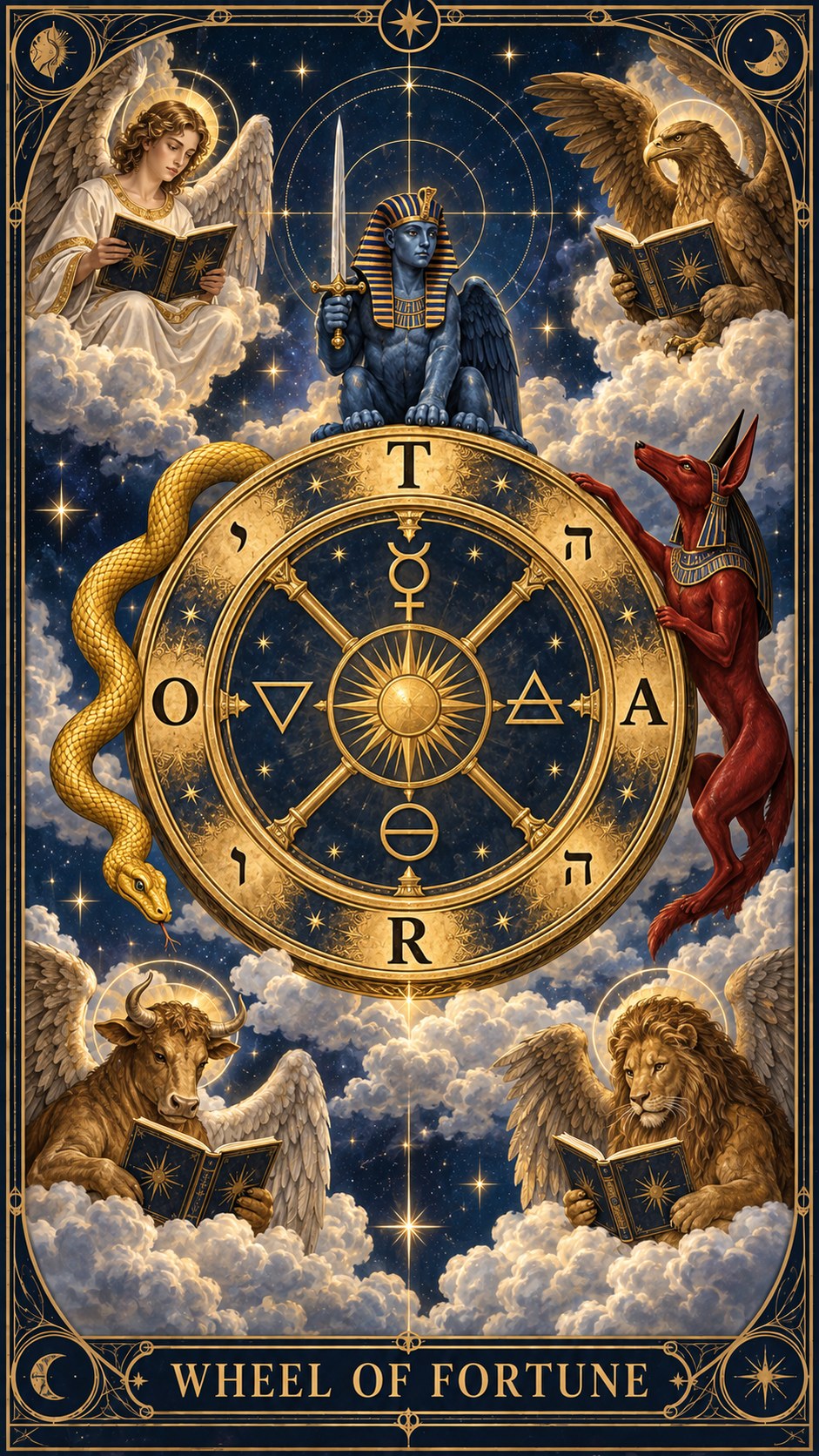
What the card shows
A wheel in motion, figures rising and falling around its rim.
Upright meaning
Nothing at the top or bottom stays there. Upright, this is a genuine turning point, often one you did not fully choose or control.
If it's your card today
Good day to notice what is shifting rather than fight to keep things exactly as they were.
Commentary and alternative readings by context
Love and relationships
In love, the Wheel suggests a relationship entering a new phase, often through circumstances outside either person's full control.
Work and decisions
For career, it points to a shift — a new opportunity or a change in direction — arriving through timing as much as effort.
As a person
The Wheel of Fortune describes someone who adapts when circumstances change and can help others regain perspective during a turn of events. Flexibility serves them better than assuming every rise or setback will last.
Reversed meaning
A cycle that feels stuck, or resistance to a change that is coming whether you resist it or not.
Where Tarot schools disagree
The main interpretation follows Rider–Waite–Smith. The Marseille and Thoth comparisons are attributed to named authors and works.
Wheel of Fortune Tarot Card: Tarot de Marseille Interpretation
Tarot de Marseille — La Roue de Fortune (Paul Marteau, 1949)
In Paul Marteau's named system in Le Tarot de Marseille (1949), La Roue de Fortune represents present action shaped by past cycles and preparing the next cycle. This is a specific twentieth-century interpretation, not an ancient meaning shared by every Marseille reader.
Wheel of Fortune Tarot Card: Crowley’s Interpretation in The Book of Thoth (1944)
Thoth — Fortune, Atu X (Aleister Crowley, 1944)
Crowley's exact corresponding card in The Book of Thoth (1944) is Fortune, Atu X. Crowley shortened the name to "Fortune" and kept the Hebrew letter Kaph and the planet Jupiter. His artwork leans into the wheel as a Qabalistic diagram of cyclical force more than a scene with figures — the descending-monkey moral of the Marseille original gives way to something closer to an abstract law of change.
Why the interpretations differ
Rider–Waite–Smith, Paul Marteau’s Marseille method and Crowley’s Thoth use different symbolic grammars. They may point to the same broad theme, but they reach it through different images, arcana order, correspondences and authorial systems. The differences above are therefore differences of method, not competing claims about one fixed universal meaning.
Sources and method
A. E. Waite — The Pictorial Key to the Tarot (1910) · Paul Marteau — Le Tarot de Marseille (BnF, 1949) · Marteau — attributed English translation · Aleister Crowley — The Book of Thoth (1944)
Automated factual and language passes completed 23 September 2026; no human native-language review is claimed.
Fire
Jupiter
Frequently asked
What does the Tarot card “Wheel of Fortune” mean upright?
Nothing at the top or bottom stays there. Upright, this is a genuine turning point, often one you did not fully choose or control.
What does the Tarot card “Wheel of Fortune” mean reversed?
A cycle that feels stuck, or resistance to a change that is coming whether you resist it or not.
What does the Tarot card “Wheel of Fortune” mean in love?
In love, the Wheel suggests a relationship entering a new phase, often through circumstances outside either person's full control.
What does the Tarot card “Wheel of Fortune” mean for career?
For career, it points to a shift — a new opportunity or a change in direction — arriving through timing as much as effort.
What kind of person does the Tarot card “Wheel of Fortune” describe?
As a person, this card describes the same pattern in character: Nothing at the top or bottom stays there. Upright, this is a genuine turning point, often one you did not fully choose or control. Under pressure, its shadow may look like this: A cycle that feels stuck, or resistance to a change that is coming whether you resist it or not.
More from Major Arcana
Ready for a full reading?
Try the free 3-card weekly spread →
New to tarot?
Learn how reading works →