Major Arcana · 0
The Fool Tarot Card Meaning
What the card shows
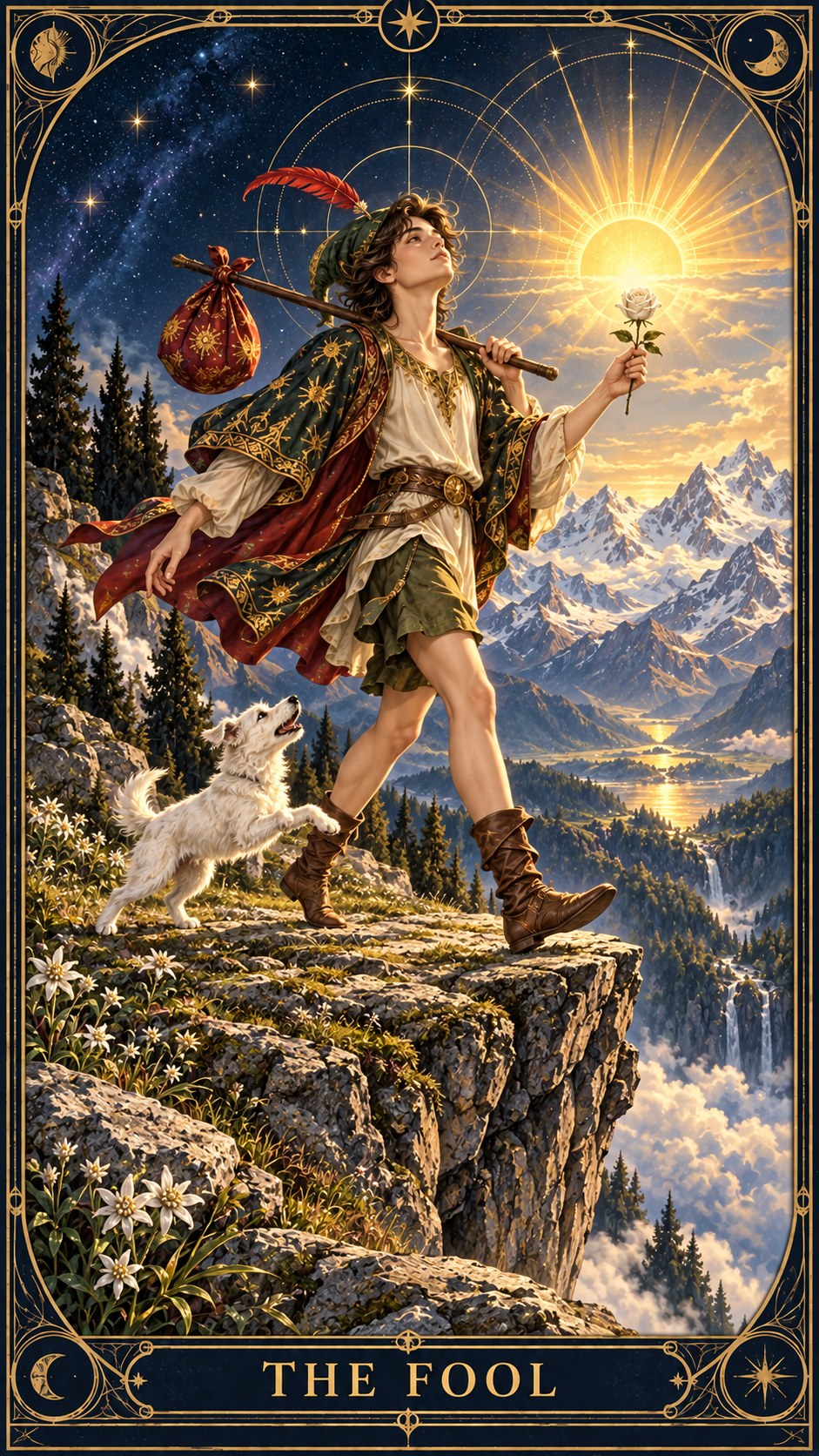
A young traveller stands at the edge of a high place, carrying a small bundle and a white rose while a white dog rises beside him. Mountains lie in the distance and the sun shines behind the figure.
Upright meaning
In contemporary Rider–Waite–Smith reading, The Fool marks a beginning whose outcome is still open: the first step, a new experience, or a choice made without a complete map. Its strength is curiosity, freedom from an old script, and willingness to learn by moving. Its risk is innocence without attention—assuming that enthusiasm will remove practical consequences. Waite's own 1910 divinatory list was much harsher and included folly, extravagance and frenzy; the constructive ‘new beginning’ emphasis belongs to the later RWS reading tradition used here.
If it's your card today
Take one small, reversible step toward the thing you keep postponing, and name the one real risk before you begin.
Commentary and alternative readings by context
Love and relationships
In relationships, The Fool can indicate a new connection, a fresh phase, or a wish to meet each other without forcing an immediate definition. Openness helps; vague promises and avoiding an honest conversation about expectations do not.
Work and decisions
At work, it points to a new role, project, skill, or independent direction. A small pilot is favoured over endless preparation, provided that money, timing, obligations, and an exit route have been checked first.
As a person
As a person, The Fool describes someone curious, unconventional, spontaneous, and willing to enter unfamiliar territory; in shadow, inexperienced, unreliable, or convinced that limits apply only to other people.
Reversed meaning
Reversed, the open beginning becomes poorly judged or blocked. It can show an impulsive leap without preparation, ignoring an obvious warning, or the opposite pattern: fear of looking foolish keeps the first step permanently postponed. The useful distinction is between a manageable experiment and a risk whose consequences you have refused to examine.
Where Tarot schools disagree
The main interpretation follows Rider–Waite–Smith. The Marseille and Thoth comparisons below are attributed to named authors, because neither tradition has one universal meaning shared by every reader.
The Fool Tarot Card: Tarot de Marseille Interpretation
Tarot de Marseille — Le Mat (Paul Marteau, 1949)
In Paul Marteau's Le Tarot de Marseille (1949), the unnumbered Le Mat is a person continually walking the path of development while carrying what has been acquired, good and bad. The emphasis is sustained movement and evolution rather than a simple ‘happy new start’; in shadow, circumstances, worries, or instinct may be pushing the traveller more than conscious choice. This is Marteau's twentieth-century system, not an ancient meaning shared by every Marseille reader.
The Fool Tarot Card: Crowley’s Interpretation in The Book of Thoth (1944)
Thoth — The Fool, Atu 0 (Aleister Crowley, 1944)
Crowley's Thoth card is also The Fool, Atu 0, attributed to Aleph and Air. In The Book of Thoth it represents the source before manifestation and an original, subtle, sudden impulse arriving from an unexpected direction. Crowley gives it spiritual associations with idea and transcendence, while a poorly received impulse can become eccentricity or folly. Compared with RWS, Thoth places less weight on a literal journey and more on raw creative energy entering form.
Why the interpretations differ
Rider–Waite–Smith, Paul Marteau’s Marseille method and Crowley’s Thoth use different symbolic grammars. They may point to the same broad theme, but they reach it through different images, arcana order, correspondences and authorial systems. The differences above are therefore differences of method, not competing claims about one fixed universal meaning.
Sources and method
A. E. Waite — The Pictorial Key to the Tarot (1910) · Paul Marteau — Le Tarot de Marseille (BnF, 1949) · Aleister Crowley — The Book of Thoth (1944)
Editorially checked 23 September 2026. Historical source statements are separated from TarotCards24's modern practical interpretation.
Air
Uranus
Frequently asked
What does the Tarot card “The Fool” mean upright?
In contemporary Rider–Waite–Smith reading, The Fool marks a beginning whose outcome is still open: the first step, a new experience, or a choice made without a complete map. Its strength is curiosity, freedom from an old script, and willingness to learn by moving. Its risk is innocence without attention—assuming that enthusiasm will remove practical consequences. Waite's own 1910 divinatory list was much harsher and included folly, extravagance and frenzy; the constructive ‘new beginning’ emphasis belongs to the later RWS reading tradition used here.
What does the Tarot card “The Fool” mean reversed?
Reversed, the open beginning becomes poorly judged or blocked. It can show an impulsive leap without preparation, ignoring an obvious warning, or the opposite pattern: fear of looking foolish keeps the first step permanently postponed. The useful distinction is between a manageable experiment and a risk whose consequences you have refused to examine.
What does the Tarot card “The Fool” mean in love?
In relationships, The Fool can indicate a new connection, a fresh phase, or a wish to meet each other without forcing an immediate definition. Openness helps; vague promises and avoiding an honest conversation about expectations do not.
What does the Tarot card “The Fool” mean for career?
At work, it points to a new role, project, skill, or independent direction. A small pilot is favoured over endless preparation, provided that money, timing, obligations, and an exit route have been checked first.
What kind of person does the Tarot card “The Fool” describe?
As a person, The Fool describes someone curious, unconventional, spontaneous, and willing to enter unfamiliar territory; in shadow, inexperienced, unreliable, or convinced that limits apply only to other people.
More from Major Arcana
Ready for a full reading?
Try the free 3-card weekly spread →
New to tarot?
Learn how reading works →