Major Arcana · 2
The High Priestess Tarot Card Meaning
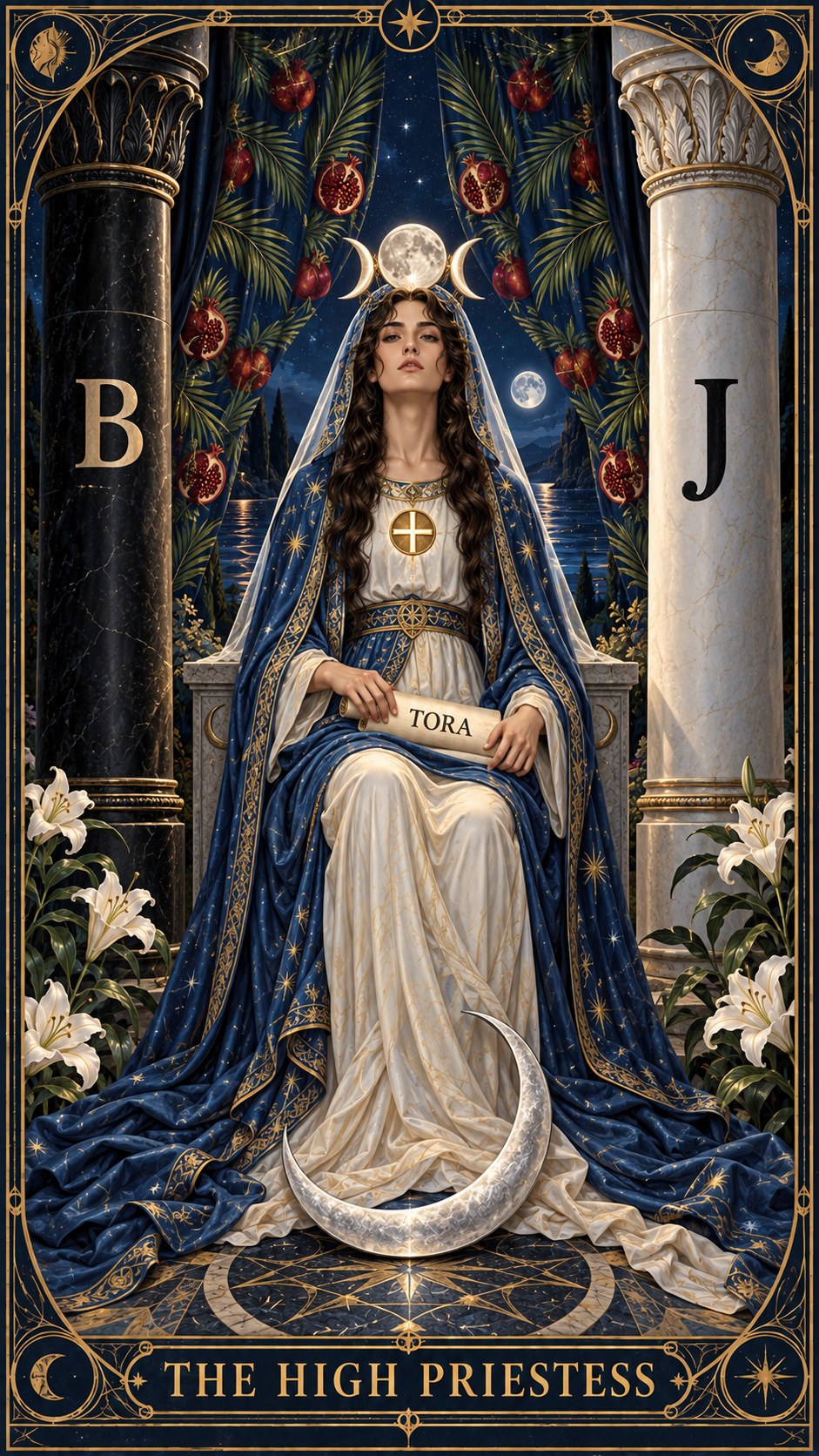
What the card shows
Seated between two pillars, a veil of pomegranates behind her, the High Priestess keeps what she knows to herself until you are ready to hear it from inside.
Upright meaning
She is a cue to stop asking others and listen to what you already sense but have not said out loud.
If it's your card today
Good day for reflection over action. If a decision feels premature, it probably is — wait for the quieter answer.
Commentary and alternative readings by context
Love and relationships
In love, The High Priestess suggests unspoken feelings or intuition about a relationship that has not been voiced yet — trust what you sense before you need proof.
Work and decisions
For career questions, she suggests information not yet fully visible — a decision or opportunity that benefits from patience rather than a fast move.
As a person
The High Priestess describes a perceptive person who listens carefully, notices what is left unsaid, and protects their privacy. Their insight is subtle; sharing a little more can prevent others from mistaking reserve for indifference.
Reversed meaning
Information withheld too long, a secret that has curdled into avoidance, or a gut feeling you are actively talking yourself out of.
Where Tarot schools disagree
The main interpretation follows Rider–Waite–Smith. The Marseille and Thoth comparisons are attributed to named authors and works.
The High Priestess Tarot Card: Tarot de Marseille Interpretation
Tarot de Marseille — La Papesse (Paul Marteau, 1949)
In Paul Marteau's named system in Le Tarot de Marseille (1949), La Papesse represents Nature's hidden riches, which must be uncovered and interpreted. This is a specific twentieth-century interpretation, not an ancient meaning shared by every Marseille reader.
The High Priestess Tarot Card: Crowley’s Interpretation in The Book of Thoth (1944)
Thoth — The Priestess, Atu II (Aleister Crowley, 1944)
Crowley's exact corresponding card in The Book of Thoth (1944) is The Priestess, Atu II. Crowley shortened the title to "The Priestess" and kept the Hebrew letter Gimel and lunar attribution used across the wider Golden Dawn system — the card of the veil between conscious and unconscious. The renaming drops the specifically Catholic imagery of "Papesse" in favor of a more generalized archetype of hidden, receptive wisdom.
Why the interpretations differ
Rider–Waite–Smith, Paul Marteau’s Marseille method and Crowley’s Thoth use different symbolic grammars. They may point to the same broad theme, but they reach it through different images, arcana order, correspondences and authorial systems. The differences above are therefore differences of method, not competing claims about one fixed universal meaning.
Sources and method
A. E. Waite — The Pictorial Key to the Tarot (1910) · Paul Marteau — Le Tarot de Marseille (BnF, 1949) · Marteau — attributed English translation · Aleister Crowley — The Book of Thoth (1944)
Automated factual and language passes completed 23 September 2026; no human native-language review is claimed.
Water
The Moon
Frequently asked
What does the Tarot card “The High Priestess” mean upright?
She is a cue to stop asking others and listen to what you already sense but have not said out loud.
What does the Tarot card “The High Priestess” mean reversed?
Information withheld too long, a secret that has curdled into avoidance, or a gut feeling you are actively talking yourself out of.
What does the Tarot card “The High Priestess” mean in love?
In love, The High Priestess suggests unspoken feelings or intuition about a relationship that has not been voiced yet — trust what you sense before you need proof.
What does the Tarot card “The High Priestess” mean for career?
For career questions, she suggests information not yet fully visible — a decision or opportunity that benefits from patience rather than a fast move.
What kind of person does the Tarot card “The High Priestess” describe?
As a person, this card describes the same pattern in character: She is a cue to stop asking others and listen to what you already sense but have not said out loud. Under pressure, its shadow may look like this: Information withheld too long, a secret that has curdled into avoidance, or a gut feeling you are actively talking yourself out of.
More from Major Arcana
Ready for a full reading?
Try the free 3-card weekly spread →
New to tarot?
Learn how reading works →