Major Arcana · 5
The Hierophant Tarot Card Meaning
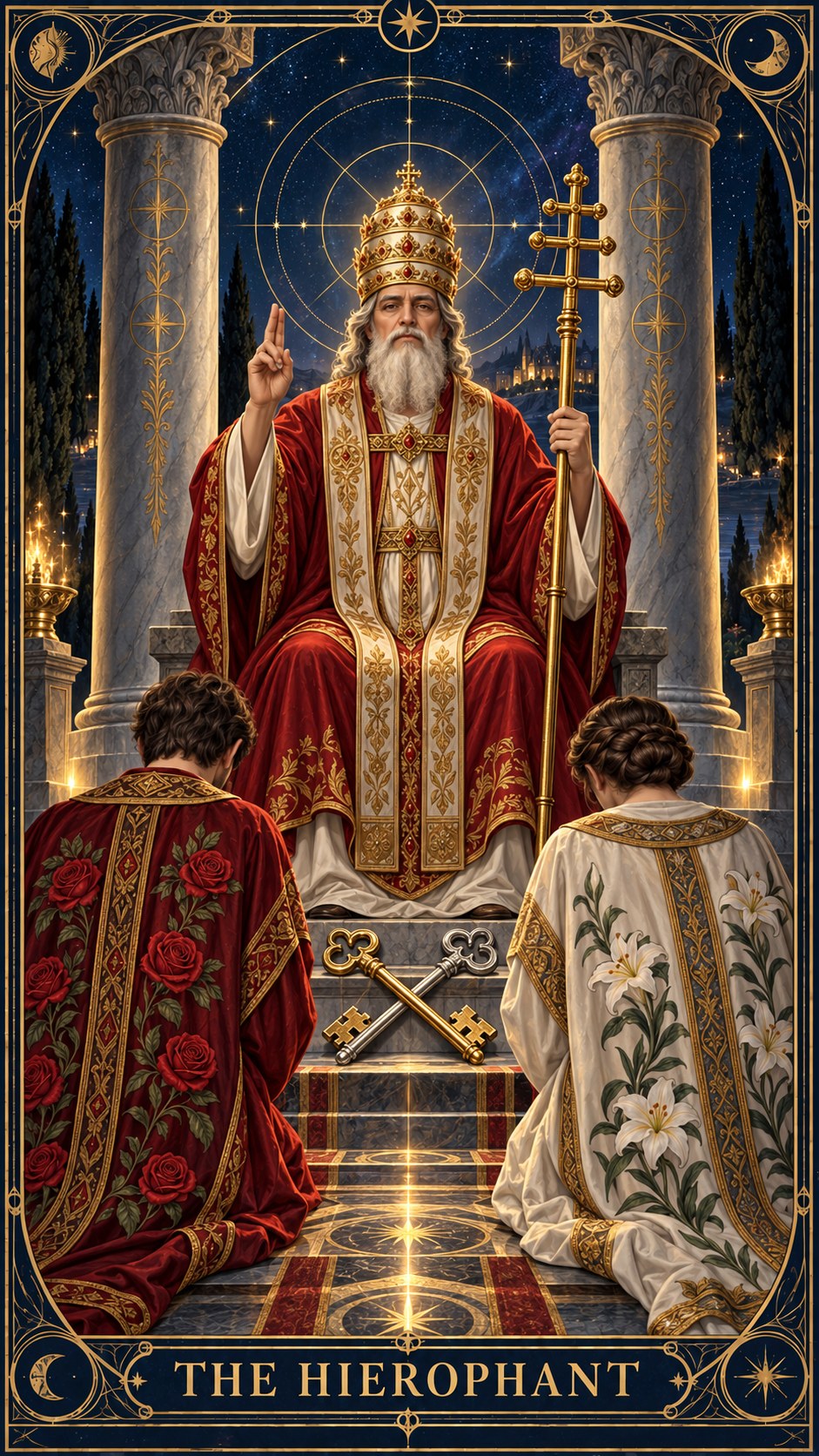
What the card shows
Two acolytes kneel before a robed teacher holding the keys to established knowledge. Upright, the Hierophant points to what is proven and shared.
Upright meaning
A mentor, an institution, a method that works because generations tested it before you.
If it's your card today
Good day to learn from someone further along, rather than reinvent the method yourself.
Commentary and alternative readings by context
Love and relationships
In love, The Hierophant can point to a traditional relationship structure — marriage, commitment through established steps — or seeking advice from someone trusted.
Work and decisions
For career, he suggests learning from a mentor, following an established path, or working within an institution rather than going it alone.
As a person
The Hierophant can describe a mentor who values shared knowledge, dependable methods, and a sense of belonging. Tradition gives them a framework; curiosity helps distinguish useful teaching from mere conformity.
Reversed meaning
Outdated convention followed out of habit, or a healthy break from a tradition that no longer serves you.
Where Tarot schools disagree
The main interpretation follows Rider–Waite–Smith. The Marseille and Thoth comparisons are attributed to named authors and works.
The Hierophant Tarot Card: Tarot de Marseille Interpretation
Tarot de Marseille — Le Pape (Paul Marteau, 1949)
In Paul Marteau's named system in Le Tarot de Marseille (1949), Le Pape represents the duty to apply spiritual teaching to action and to accept its laws. This is a specific twentieth-century interpretation, not an ancient meaning shared by every Marseille reader.
The Hierophant Tarot Card: Crowley’s Interpretation in The Book of Thoth (1944)
Thoth — The Hierophant, Atu V (Aleister Crowley, 1944)
Crowley's exact corresponding card in The Book of Thoth (1944) is The Hierophant, Atu V. Crowley kept the Hebrew letter Vau and the sign Taurus from the standard Golden Dawn table. His own commentary treats the card as the revealer of hidden things through inspired teaching rather than institutional office — closer in spirit to RWS's reading than Marseille's literal Papal figure is, despite both non-RWS decks sharing older Christian-hierarchy roots.
Why the interpretations differ
Rider–Waite–Smith, Paul Marteau’s Marseille method and Crowley’s Thoth use different symbolic grammars. They may point to the same broad theme, but they reach it through different images, arcana order, correspondences and authorial systems. The differences above are therefore differences of method, not competing claims about one fixed universal meaning.
Sources and method
A. E. Waite — The Pictorial Key to the Tarot (1910) · Paul Marteau — Le Tarot de Marseille (BnF, 1949) · Marteau — attributed English translation · Aleister Crowley — The Book of Thoth (1944)
Automated factual and language passes completed 23 September 2026; no human native-language review is claimed.
Earth
Taurus
Frequently asked
What does the Tarot card “The Hierophant” mean upright?
A mentor, an institution, a method that works because generations tested it before you.
What does the Tarot card “The Hierophant” mean reversed?
Outdated convention followed out of habit, or a healthy break from a tradition that no longer serves you.
What does the Tarot card “The Hierophant” mean in love?
In love, The Hierophant can point to a traditional relationship structure — marriage, commitment through established steps — or seeking advice from someone trusted.
What does the Tarot card “The Hierophant” mean for career?
For career, he suggests learning from a mentor, following an established path, or working within an institution rather than going it alone.
What kind of person does the Tarot card “The Hierophant” describe?
As a person, this card describes the same pattern in character: A mentor, an institution, a method that works because generations tested it before you. Under pressure, its shadow may look like this: Outdated convention followed out of habit, or a healthy break from a tradition that no longer serves you.
More from Major Arcana
Ready for a full reading?
Try the free 3-card weekly spread →
New to tarot?
Learn how reading works →