Major Arcana · 4
The Emperor Tarot Card Meaning
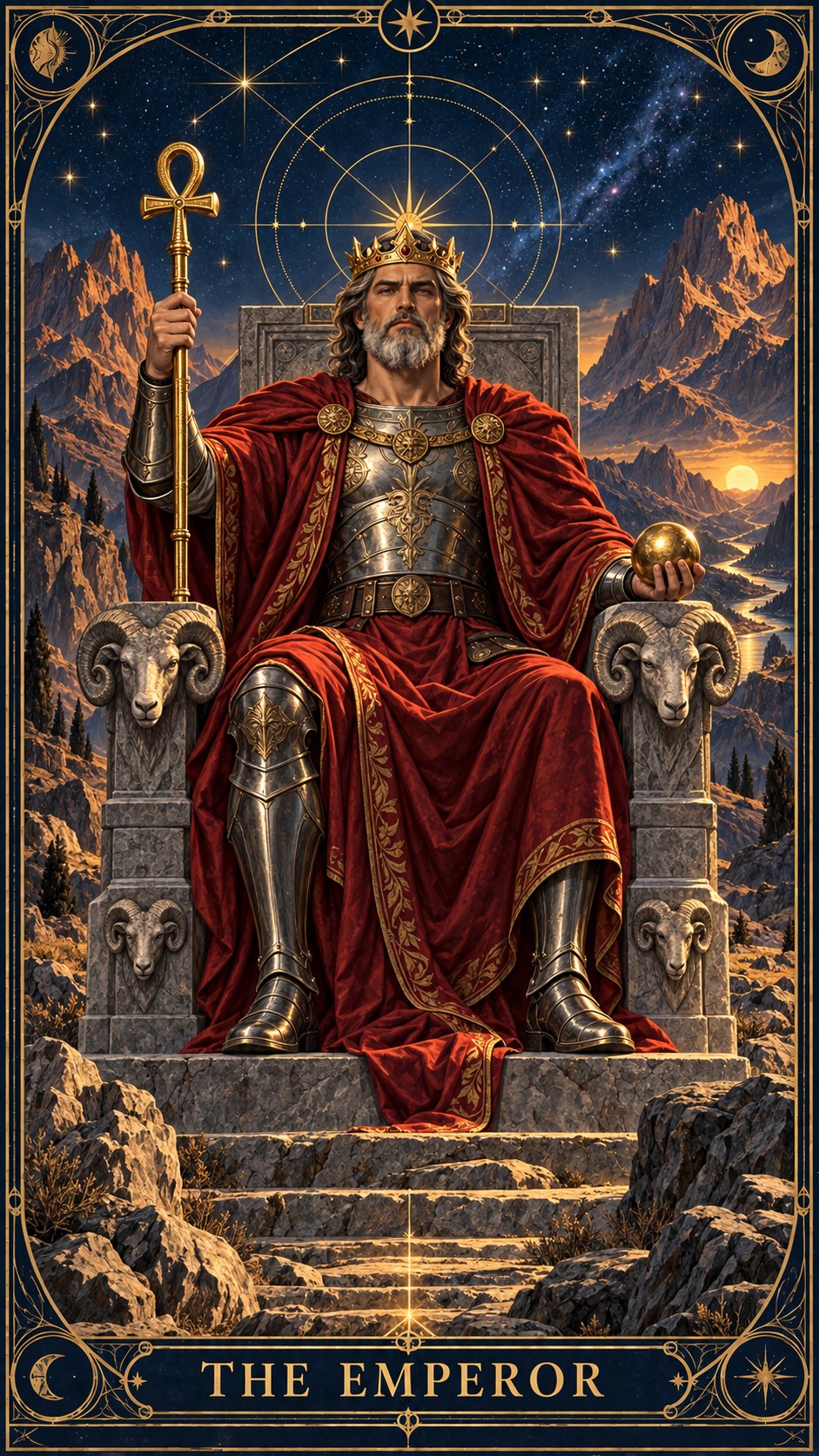
What the card shows
A stone throne, a ram-headed armrest, a man who has built something durable and intends to keep it that way. Upright, the Emperor is structure that actually holds.
Upright meaning
Rules, boundaries, or a plan worth sticking to.
If it's your card today
Useful day to set a boundary or commit to a plan you have been leaving loose.
Commentary and alternative readings by context
Love and relationships
In love, The Emperor suggests a stable, structured relationship or a partner who provides security — reversed, it can point to control or rigidity.
Work and decisions
For career questions, he points to authority, leadership, or the need to set clear boundaries and structure around a project.
As a person
The Emperor describes someone who creates structure, keeps agreements, and wants responsibilities to be clear. They offer stability; flexibility matters when a good rule no longer fits the people it was meant to serve.
Reversed meaning
Control tipping into rigidity, or the opposite — a complete absence of structure where some would genuinely help.
Where Tarot schools disagree
The main interpretation follows Rider–Waite–Smith. The Marseille and Thoth comparisons are attributed to named authors and works.
The Emperor Tarot Card: Tarot de Marseille Interpretation
Tarot de Marseille — L’Empereur (Paul Marteau, 1949)
In Paul Marteau's named system in Le Tarot de Marseille (1949), L’Empereur represents material force giving temporary reality and order to what is still unstable. This is a specific twentieth-century interpretation, not an ancient meaning shared by every Marseille reader.
The Emperor Tarot Card: Crowley’s Interpretation in The Book of Thoth (1944)
Thoth — The Emperor, Atu IV (Aleister Crowley, 1944)
Crowley's exact corresponding card in The Book of Thoth (1944) is The Emperor, Atu IV. This is the one card where Crowley made a documented, deliberate break from the standard Golden Dawn table he otherwise followed. Citing a line from his own Thelemic scripture ("Tzaddi is not the Star"), he swapped the Hebrew letter Tzaddi from The Star onto The Emperor (keeping Aries as the sign) — a change unique to his system and explicitly tied to his own religious framework, not a scholarly correction of an older tradition.
Why the interpretations differ
Rider–Waite–Smith, Paul Marteau’s Marseille method and Crowley’s Thoth use different symbolic grammars. They may point to the same broad theme, but they reach it through different images, arcana order, correspondences and authorial systems. The differences above are therefore differences of method, not competing claims about one fixed universal meaning.
Sources and method
A. E. Waite — The Pictorial Key to the Tarot (1910) · Paul Marteau — Le Tarot de Marseille (BnF, 1949) · Marteau — attributed English translation · Aleister Crowley — The Book of Thoth (1944)
Automated factual and language passes completed 23 September 2026; no human native-language review is claimed.
Fire
Aries
Frequently asked
What does the Tarot card “The Emperor” mean upright?
Rules, boundaries, or a plan worth sticking to.
What does the Tarot card “The Emperor” mean reversed?
Control tipping into rigidity, or the opposite — a complete absence of structure where some would genuinely help.
What does the Tarot card “The Emperor” mean in love?
In love, The Emperor suggests a stable, structured relationship or a partner who provides security — reversed, it can point to control or rigidity.
What does the Tarot card “The Emperor” mean for career?
For career questions, he points to authority, leadership, or the need to set clear boundaries and structure around a project.
What kind of person does the Tarot card “The Emperor” describe?
As a person, this card describes the same pattern in character: Rules, boundaries, or a plan worth sticking to. Under pressure, its shadow may look like this: Control tipping into rigidity, or the opposite — a complete absence of structure where some would genuinely help.
More from Major Arcana
Ready for a full reading?
Try the free 3-card weekly spread →
New to tarot?
Learn how reading works →