Major Arcana · 13
Death Tarot Card Meaning
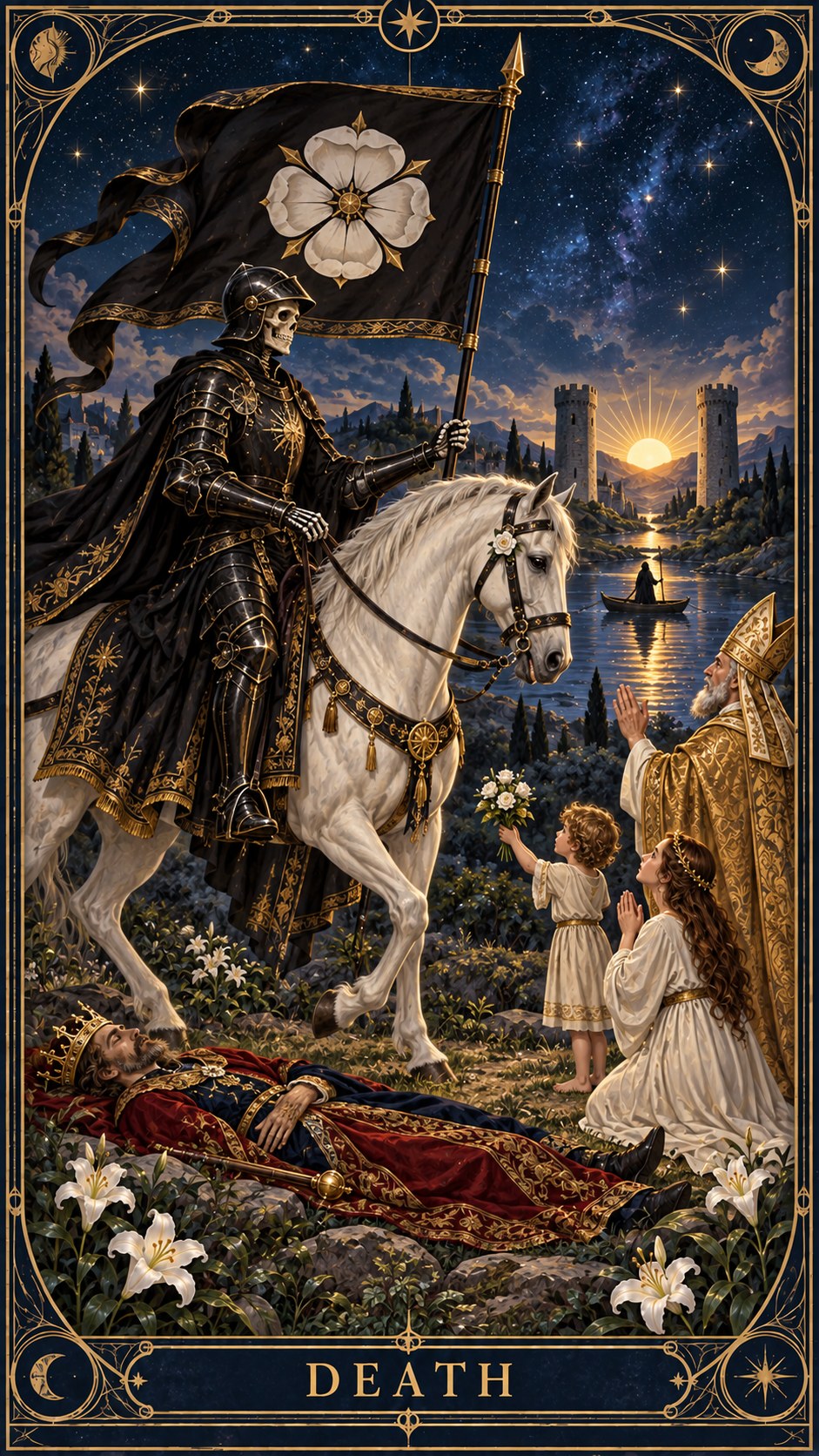
What the card shows
A skeletal figure on horseback, a fallen king, a rising sun in the distance.
Upright meaning
The card people are most afraid to pull, and almost never about literal death. Upright, Death marks the honest end of a chapter: a habit, a relationship, an identity that has run its course, clearing space for what comes after. Fear of this card usually says more about resistance to change than about the situation itself.
If it's your card today
Something is ready to be let go of. The card is asking you to stop holding the door open for it.
Commentary and alternative readings by context
Love and relationships
In love, Death points to a real ending — a relationship, phase, or dynamic that has genuinely run its course, making room for what comes next rather than a literal loss.
Work and decisions
For career, it suggests a role, project, or way of working that needs to end for something better to begin.
As a person
Death describes someone willing to end a chapter once it has run its course, even when change unsettles the people around them. Their gift is renewal; their challenge is to explain the transition rather than disappear into it.
Reversed meaning
An ending being resisted or dragged out past its natural point, or a transformation half-finished.
Where Tarot schools disagree
The main interpretation follows Rider–Waite–Smith. The Marseille and Thoth comparisons are attributed to named authors and works.
Death Tarot Card: Tarot de Marseille Interpretation
Tarot de Marseille — Arcane XIII (Paul Marteau, 1949)
In Paul Marteau's named system in Le Tarot de Marseille (1949), Arcane XIII represents a change of consciousness between the end of one cycle and the start of another. This is a specific twentieth-century interpretation, not an ancient meaning shared by every Marseille reader.
Death Tarot Card: Crowley’s Interpretation in The Book of Thoth (1944)
Thoth — Death, Atu XIII (Aleister Crowley, 1944)
Crowley's exact corresponding card in The Book of Thoth (1944) is Death, Atu XIII. Crowley assigns Death the Hebrew letter Nun ("fish") and the sign Scorpio, and the Harris artwork is explicitly alchemical: a dancing skeleton moving among transforming creatures — fish, serpent, eagle, scorpion. The framing is putrefaction as a creative act — decomposition as the literal precondition for new life, a more visceral, bodily image than RWS's quieter "end of a chapter."
Why the interpretations differ
Rider–Waite–Smith, Paul Marteau’s Marseille method and Crowley’s Thoth use different symbolic grammars. They may point to the same broad theme, but they reach it through different images, arcana order, correspondences and authorial systems. The differences above are therefore differences of method, not competing claims about one fixed universal meaning.
Sources and method
A. E. Waite — The Pictorial Key to the Tarot (1910) · Paul Marteau — Le Tarot de Marseille (BnF, 1949) · Marteau — attributed English translation · Aleister Crowley — The Book of Thoth (1944)
Automated factual and language passes completed 23 September 2026; no human native-language review is claimed.
Water
Scorpio
On screen vs. in a real reading
Death is one of the cards filmmakers reach for most — see how the on-screen version compares to what it actually means in why tarot keeps showing up in movies and TV.
Frequently asked
What does the Tarot card “Death” mean upright?
The card people are most afraid to pull, and almost never about literal death. Upright, Death marks the honest end of a chapter: a habit, a relationship, an identity that has run its course, clearing space for what comes after. Fear of this card usually says more about resistance to change than about the situation itself.
What does the Tarot card “Death” mean reversed?
An ending being resisted or dragged out past its natural point, or a transformation half-finished.
What does the Tarot card “Death” mean in love?
In love, Death points to a real ending — a relationship, phase, or dynamic that has genuinely run its course, making room for what comes next rather than a literal loss.
What does the Tarot card “Death” mean for career?
For career, it suggests a role, project, or way of working that needs to end for something better to begin.
What kind of person does the Tarot card “Death” describe?
As a person, this card describes the same pattern in character: The card people are most afraid to pull, and almost never about literal death. Upright, Death marks the honest end of a chapter: a habit, a relationship, an identity that has run its course, clearing space for what comes after. Fear of this card usually says more about resistance to change than about the situation itself. Under pressure, its shadow may look like this: An ending being resisted or dragged out past its natural point, or a transformation half-finished.
More from Major Arcana
Ready for a full reading?
Try the free 3-card weekly spread →
New to tarot?
Learn how reading works →