Cups
Four of Cups Tarot Card Meaning
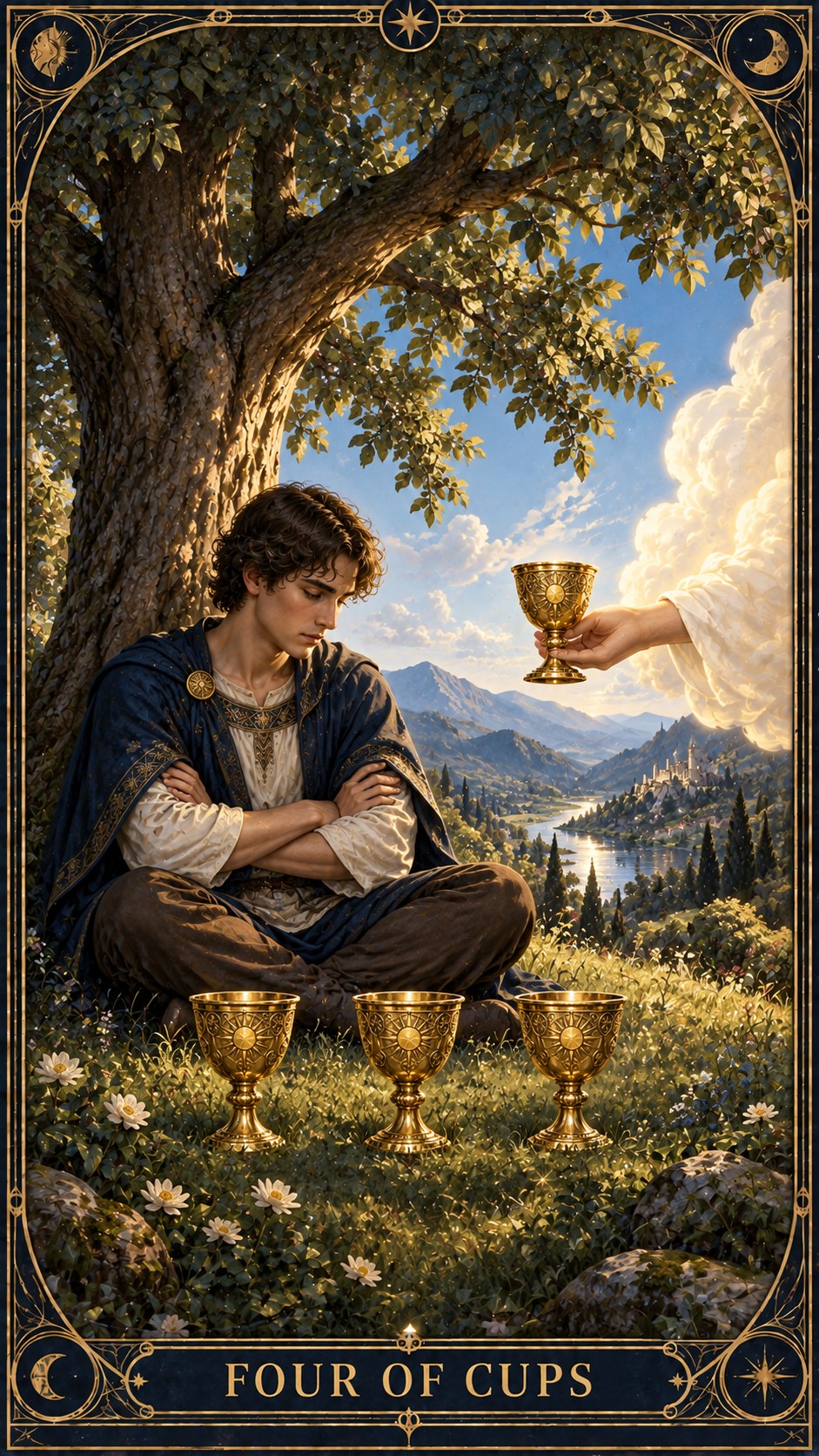
What the card shows
A seated figure ignores a cup being offered, arms crossed, lost in thought.
Upright meaning
An opportunity right in front of him that he’s too withdrawn to notice. Upright, Four of Cups is disengagement, sometimes for good reason, sometimes just habit.
If it's your card today
If something feels flat today, check whether you’re missing an offer worth a second look.
Commentary and alternative readings by context
Love and relationships
In love, it suggests emotional withdrawal or taking a partner for granted — an offer of connection going unnoticed.
Work and decisions
For career, it points to disengagement or missing an opportunity because you are too withdrawn to notice it.
As a person
The Four of Cups may describe an inward-looking person who needs time to understand what they actually want. Reflection helps them choose honestly, though staying turned inward can make a sincere invitation easy to miss.
Reversed meaning
Finally noticing the offer, or restlessness breaking through the apathy.
Where Tarot schools disagree
The main interpretation follows Rider–Waite–Smith. The Marseille and Thoth comparisons are attributed to named authors and works.
Four of Cups Tarot Card: Tarot de Marseille Interpretation
Tarot de Marseille — Quatre de Coupes (Paul Marteau, 1949)
In Paul Marteau's number-and-suit method in Le Tarot de Marseille (1949), this rank means relative stability, order, consolidation, and security. Cups describe receptive feeling, from spiritual love to human affection. Read together, the card applies that stage to this suit's domain. This is Marteau's specific twentieth-century system.
Four of Cups Tarot Card: Crowley’s Interpretation in The Book of Thoth (1944)
Thoth — Four of Cups — Luxury (Aleister Crowley, 1944)
Crowley's exact corresponding card in The Book of Thoth (1944) is Four of Cups — Luxury. The decan is "Luxury," ruled by the Moon in Cancer — the Moon in its own sign, the single most "at home" placement possible for a water card. Crowley's reading is contentment mixed with something bittersweet, closer to RWS's quiet dissatisfaction than the plainly positive Marseille numerology would suggest on its own.
Why the interpretations differ
RWS builds much of the reading from Pamela Colman Smith’s narrative scene. Marseille numbered minors are usually read through number, suit and composition, while Thoth adds a printed title and astrological or decan structure. The systems can begin with the same number and suit yet emphasize different dynamics.
Sources and method
A. E. Waite — The Pictorial Key to the Tarot (1910) · Paul Marteau — Le Tarot de Marseille (BnF, 1949) · Marteau — attributed English translation · Aleister Crowley — The Book of Thoth (1944)
Automated factual and language passes completed 23 September 2026; no human native-language review is claimed.
Water
Frequently asked
What does the Tarot card “Four of Cups” mean upright?
An opportunity right in front of him that he’s too withdrawn to notice. Upright, Four of Cups is disengagement, sometimes for good reason, sometimes just habit.
What does the Tarot card “Four of Cups” mean reversed?
Finally noticing the offer, or restlessness breaking through the apathy.
What does the Tarot card “Four of Cups” mean in love?
In love, it suggests emotional withdrawal or taking a partner for granted — an offer of connection going unnoticed.
What does the Tarot card “Four of Cups” mean for career?
For career, it points to disengagement or missing an opportunity because you are too withdrawn to notice it.
What kind of person does the Tarot card “Four of Cups” describe?
As a person, this card describes the same pattern in character: An opportunity right in front of him that he’s too withdrawn to notice. Upright, Four of Cups is disengagement, sometimes for good reason, sometimes just habit. Under pressure, its shadow may look like this: Finally noticing the offer, or restlessness breaking through the apathy.
Related cards
Ready for a full reading?
Try the free 3-card weekly spread →
New to tarot?
Learn how reading works →