Swords
Five of Swords Tarot Card Meaning
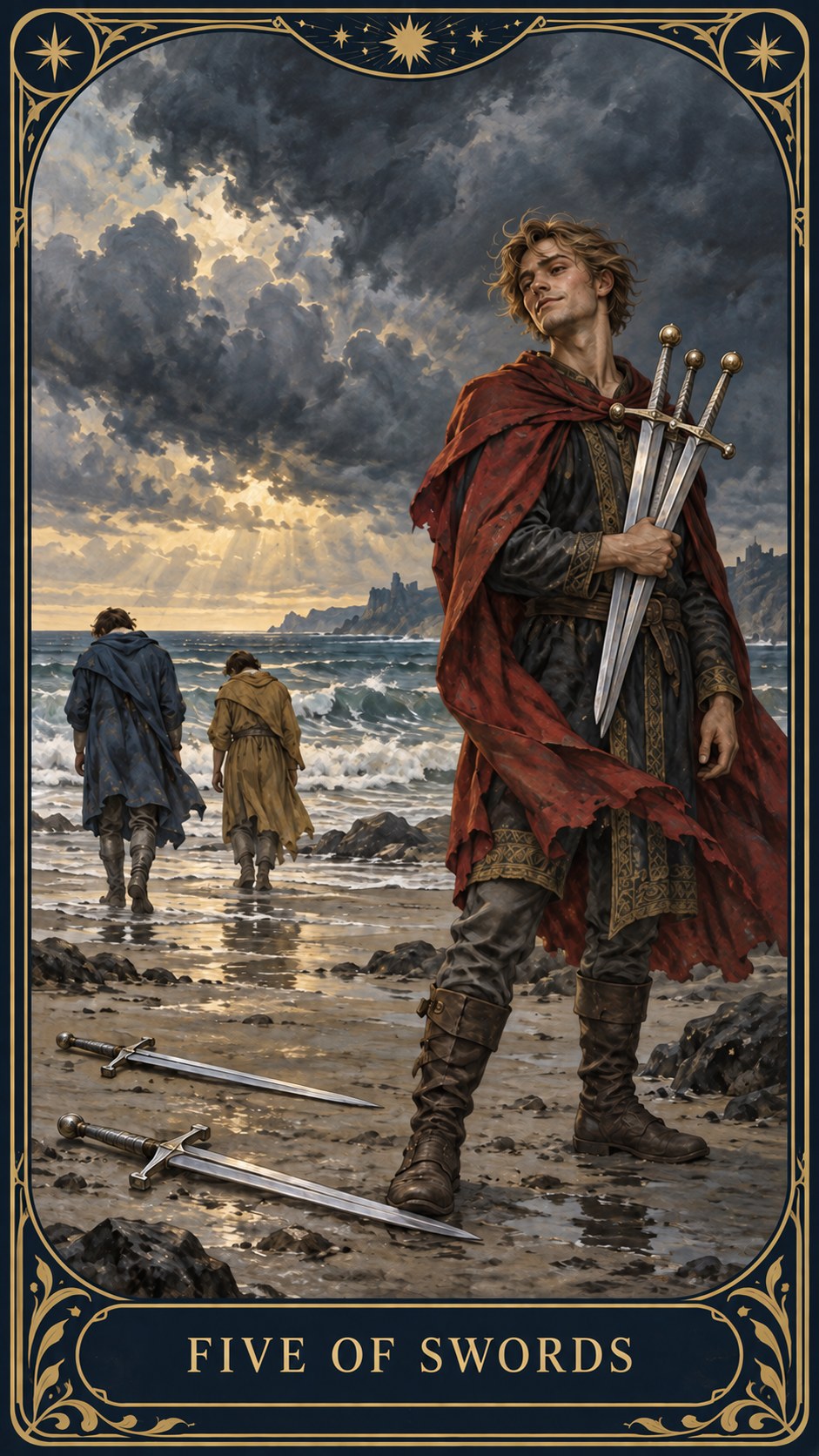
What the card shows
A figure gathers up swords while two others walk away defeated.
Upright meaning
A win that costs more in the relationship than it gains. Upright, Five of Swords is a conflict where winning isn’t actually worth it.
If it's your card today
Worth asking today whether a fight is actually worth having, even if you’d win it.
Commentary and alternative readings by context
Love and relationships
In love, it suggests a conflict "won" in a way that damages the relationship more than it resolves anything.
Work and decisions
For career, it points to office conflict or competition where winning costs more in trust than it is worth.
As a person
The Five of Swords describes a sharp strategist who wants to understand the terms of a conflict and avoid being outplayed. Their challenge is to ask whether winning this exchange is worth the damage to trust.
Reversed meaning
Reconciliation after conflict, or finally recognising a win wasn’t worth the cost.
Where Tarot schools disagree
The main interpretation follows Rider–Waite–Smith. The Marseille and Thoth comparisons are attributed to named authors and works.
Five of Swords Tarot Card: Tarot de Marseille Interpretation
Tarot de Marseille — Cinq de Épées (Paul Marteau, 1949)
In Paul Marteau's number-and-suit method in Le Tarot de Marseille (1949), this rank means transition from one plane to another, with energy becoming multiple and diffuse. Swords describe action on the material plane that can open toward spiritual value. Read together, the card applies that stage to this suit's domain. This is Marteau's specific twentieth-century system.
Five of Swords Tarot Card: Crowley’s Interpretation in The Book of Thoth (1944)
Thoth — Five of Swords — Defeat (Aleister Crowley, 1944)
Crowley's exact corresponding card in The Book of Thoth (1944) is Five of Swords — Defeat. The decan title is bluntly "Defeat," ruled by Venus in Aquarius — harmony and attraction (Venus) struggling in Aquarius's detached, unconventional air. Crowley's own commentary reads this card as harsher than RWS's: not an ambiguous hollow victory but a clean, cold loss.
Why the interpretations differ
RWS builds much of the reading from Pamela Colman Smith’s narrative scene. Marseille numbered minors are usually read through number, suit and composition, while Thoth adds a printed title and astrological or decan structure. The systems can begin with the same number and suit yet emphasize different dynamics.
Sources and method
A. E. Waite — The Pictorial Key to the Tarot (1910) · Paul Marteau — Le Tarot de Marseille (BnF, 1949) · Marteau — attributed English translation · Aleister Crowley — The Book of Thoth (1944)
Automated factual and language passes completed 23 September 2026; no human native-language review is claimed.
Air
Frequently asked
What does the Tarot card “Five of Swords” mean upright?
A win that costs more in the relationship than it gains. Upright, Five of Swords is a conflict where winning isn’t actually worth it.
What does the Tarot card “Five of Swords” mean reversed?
Reconciliation after conflict, or finally recognising a win wasn’t worth the cost.
What does the Tarot card “Five of Swords” mean in love?
In love, it suggests a conflict "won" in a way that damages the relationship more than it resolves anything.
What does the Tarot card “Five of Swords” mean for career?
For career, it points to office conflict or competition where winning costs more in trust than it is worth.
What kind of person does the Tarot card “Five of Swords” describe?
As a person, this card describes the same pattern in character: A win that costs more in the relationship than it gains. Upright, Five of Swords is a conflict where winning isn’t actually worth it. Under pressure, its shadow may look like this: Reconciliation after conflict, or finally recognising a win wasn’t worth the cost.
Related cards
Ready for a full reading?
Try the free 3-card weekly spread →
New to tarot?
Learn how reading works →