Wands
Three of Wands Tarot Card Meaning
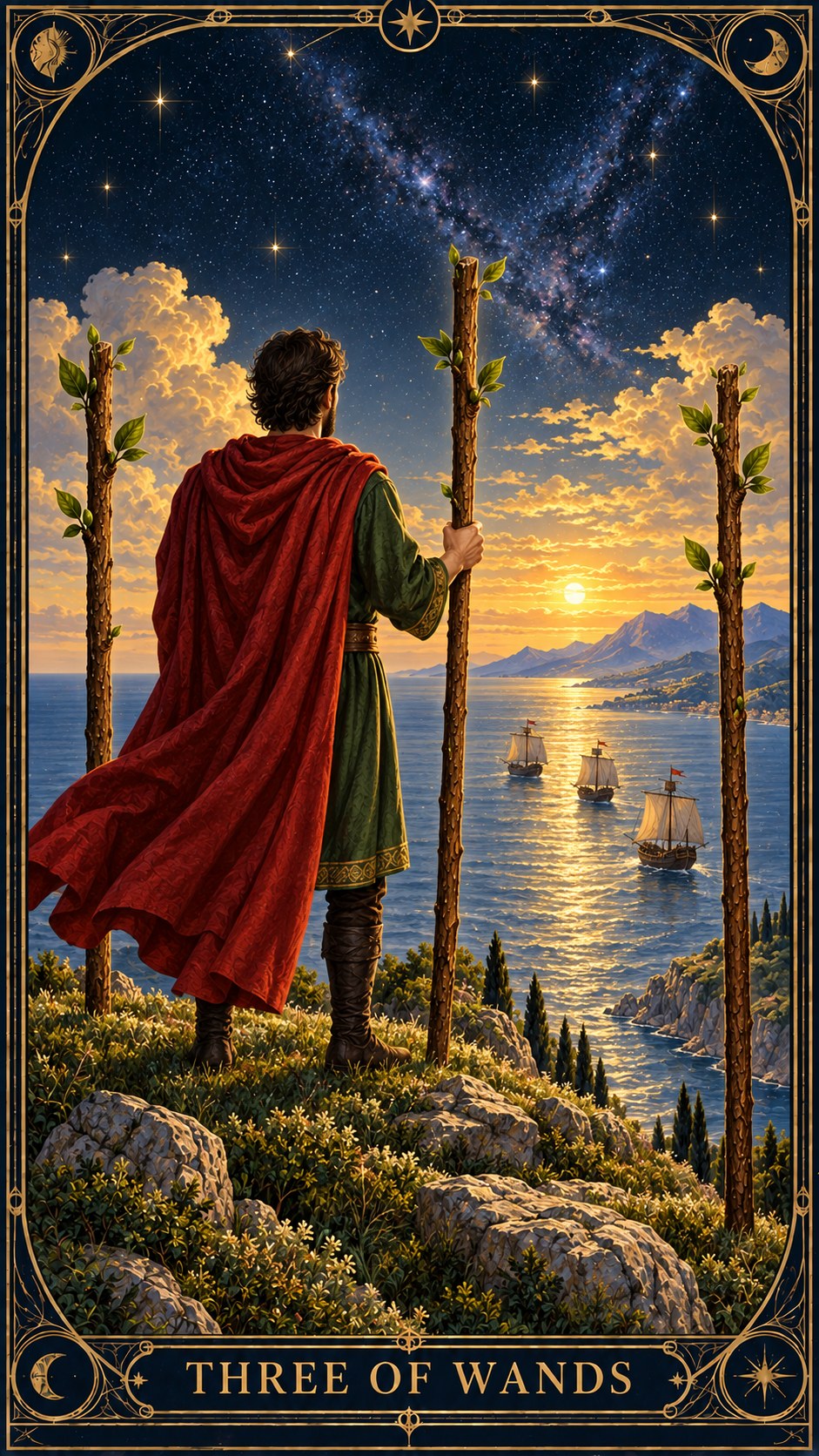
What the card shows
Ships on the horizon, watched from a cliff.
Upright meaning
The work is out in the world now, and results are on their way but not here yet. Upright, Three of Wands is patient confidence in something already set in motion.
If it's your card today
What you started is still in motion — resist the urge to check on it every hour.
Commentary and alternative readings by context
Love and relationships
In love, it suggests a relationship or decision whose outcome is already in motion but not yet visible — patience while something develops.
Work and decisions
For career, it points to a project or investment that has been launched and is now, quite literally, on its way back to you.
As a person
The Three of Wands points to someone who thinks beyond the immediate task and is willing to let good work travel. Their foresight is valuable; attending to present relationships keeps ambition grounded.
Reversed meaning
Delays that test that patience, or overconfidence about a return that hasn’t arrived yet.
Where Tarot schools disagree
The main interpretation follows Rider–Waite–Smith. The Marseille and Thoth comparisons are attributed to named authors and works.
Three of Wands Tarot Card: Tarot de Marseille Interpretation
Tarot de Marseille — Trois de Bâtons (Paul Marteau, 1949)
In Paul Marteau's number-and-suit method in Le Tarot de Marseille (1949), this rank means activity entering potential and giving its development a direction. Batons use material force to build, cultivate, and direct. Read together, the card applies that stage to this suit's domain. This is Marteau's specific twentieth-century system.
Three of Wands Tarot Card: Crowley’s Interpretation in The Book of Thoth (1944)
Thoth — Three of Wands — Virtue (Aleister Crowley, 1944)
Crowley's exact corresponding card in The Book of Thoth (1944) is Three of Wands — Virtue. The decan is "Virtue," ruled by the Sun in Aries — the Sun exalted in its most self-assertive fire sign. Crowley's reading leans into confident, already-proven momentum rather than the RWS image of a trader watching ships still out at sea.
Why the interpretations differ
RWS builds much of the reading from Pamela Colman Smith’s narrative scene. Marseille numbered minors are usually read through number, suit and composition, while Thoth adds a printed title and astrological or decan structure. The systems can begin with the same number and suit yet emphasize different dynamics.
Sources and method
A. E. Waite — The Pictorial Key to the Tarot (1910) · Paul Marteau — Le Tarot de Marseille (BnF, 1949) · Marteau — attributed English translation · Aleister Crowley — The Book of Thoth (1944)
Automated factual and language passes completed 23 September 2026; no human native-language review is claimed.
Fire
Frequently asked
What does the Tarot card “Three of Wands” mean upright?
The work is out in the world now, and results are on their way but not here yet. Upright, Three of Wands is patient confidence in something already set in motion.
What does the Tarot card “Three of Wands” mean reversed?
Delays that test that patience, or overconfidence about a return that hasn’t arrived yet.
What does the Tarot card “Three of Wands” mean in love?
In love, it suggests a relationship or decision whose outcome is already in motion but not yet visible — patience while something develops.
What does the Tarot card “Three of Wands” mean for career?
For career, it points to a project or investment that has been launched and is now, quite literally, on its way back to you.
What kind of person does the Tarot card “Three of Wands” describe?
As a person, this card describes the same pattern in character: The work is out in the world now, and results are on their way but not here yet. Upright, Three of Wands is patient confidence in something already set in motion. Under pressure, its shadow may look like this: Delays that test that patience, or overconfidence about a return that hasn’t arrived yet.
Related cards
Ready for a full reading?
Try the free 3-card weekly spread →
New to tarot?
Learn how reading works →