Pentacles
Seven of Pentacles Tarot Card Meaning
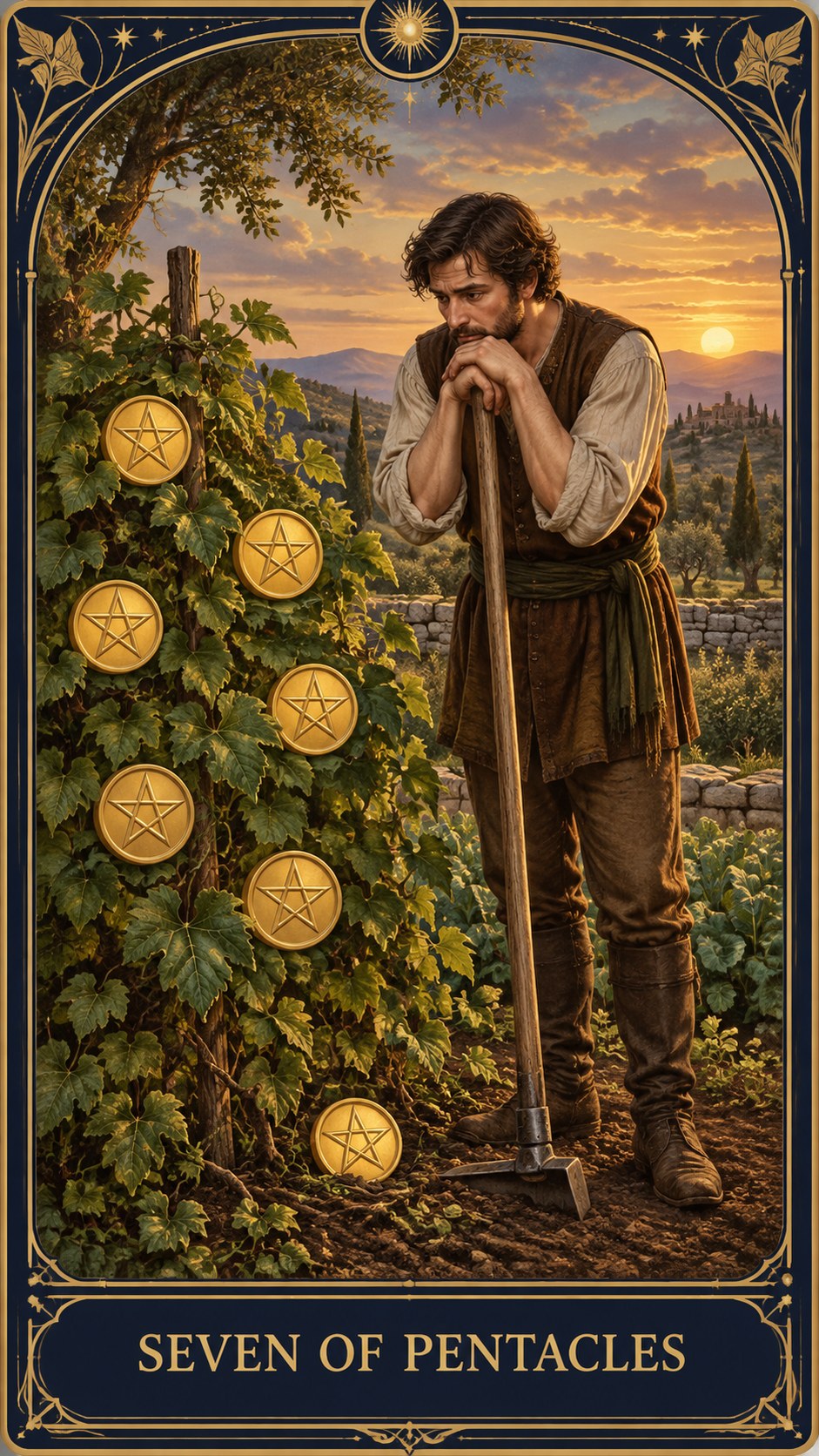
What the card shows
A farmer leans on his tool, studying a bush heavy with pentacles not quite ready to harvest.
Upright meaning
The work is done, now it’s about waiting well. Upright, Seven of Pentacles is patient assessment of something still growing.
If it's your card today
Worth a real, honest check today on whether a long-term effort is still worth the wait.
Commentary and alternative readings by context
Love and relationships
In love, it suggests patiently assessing whether a relationship you have invested in is still worth the continued effort.
Work and decisions
For career, it points to evaluating a long-term project or investment honestly before deciding whether to keep going.
As a person
The Seven of Pentacles suits someone who can work patiently without demanding instant proof of success. They understand long-term growth; periodic review helps them invest effort where it still has a future.
Reversed meaning
Impatience that risks the harvest, or investing more time into something that has stopped paying off.
Where Tarot schools disagree
The main interpretation follows Rider–Waite–Smith. The Marseille and Thoth comparisons are attributed to named authors and works.
Seven of Pentacles Tarot Card: Tarot de Marseille Interpretation
Tarot de Marseille — Sept de Deniers (Paul Marteau, 1949)
In Paul Marteau's number-and-suit method in Le Tarot de Marseille (1949), this rank means stored power put into action while harmony is maintained. Coins make inner riches concrete through intelligence and work. Read together, the card applies that stage to this suit's domain. This is Marteau's specific twentieth-century system.
Seven of Pentacles Tarot Card: Crowley’s Interpretation in The Book of Thoth (1944)
Thoth — Seven of Disks — Failure (Aleister Crowley, 1944)
Crowley's exact corresponding card in The Book of Thoth (1944) is Seven of Disks — Failure. The decan title, "Failure," ruled by Saturn in Taurus — restriction (Saturn) slowing Taurus's usual steady growth — matches RWS's wait-and-see imagery closely: labor invested, results not yet in hand, a genuinely close independent convergence between astrology and picture.
Why the interpretations differ
RWS builds much of the reading from Pamela Colman Smith’s narrative scene. Marseille numbered minors are usually read through number, suit and composition, while Thoth adds a printed title and astrological or decan structure. The systems can begin with the same number and suit yet emphasize different dynamics.
Sources and method
A. E. Waite — The Pictorial Key to the Tarot (1910) · Paul Marteau — Le Tarot de Marseille (BnF, 1949) · Marteau — attributed English translation · Aleister Crowley — The Book of Thoth (1944)
Automated factual and language passes completed 23 September 2026; no human native-language review is claimed.
Earth
Frequently asked
What does the Tarot card “Seven of Pentacles” mean upright?
The work is done, now it’s about waiting well. Upright, Seven of Pentacles is patient assessment of something still growing.
What does the Tarot card “Seven of Pentacles” mean reversed?
Impatience that risks the harvest, or investing more time into something that has stopped paying off.
What does the Tarot card “Seven of Pentacles” mean in love?
In love, it suggests patiently assessing whether a relationship you have invested in is still worth the continued effort.
What does the Tarot card “Seven of Pentacles” mean for career?
For career, it points to evaluating a long-term project or investment honestly before deciding whether to keep going.
What kind of person does the Tarot card “Seven of Pentacles” describe?
As a person, this card describes the same pattern in character: The work is done, now it’s about waiting well. Upright, Seven of Pentacles is patient assessment of something still growing. Under pressure, its shadow may look like this: Impatience that risks the harvest, or investing more time into something that has stopped paying off.
Related cards
Ready for a full reading?
Try the free 3-card weekly spread →
New to tarot?
Learn how reading works →