Swords
Knight of Swords Tarot Card Meaning
What the card shows
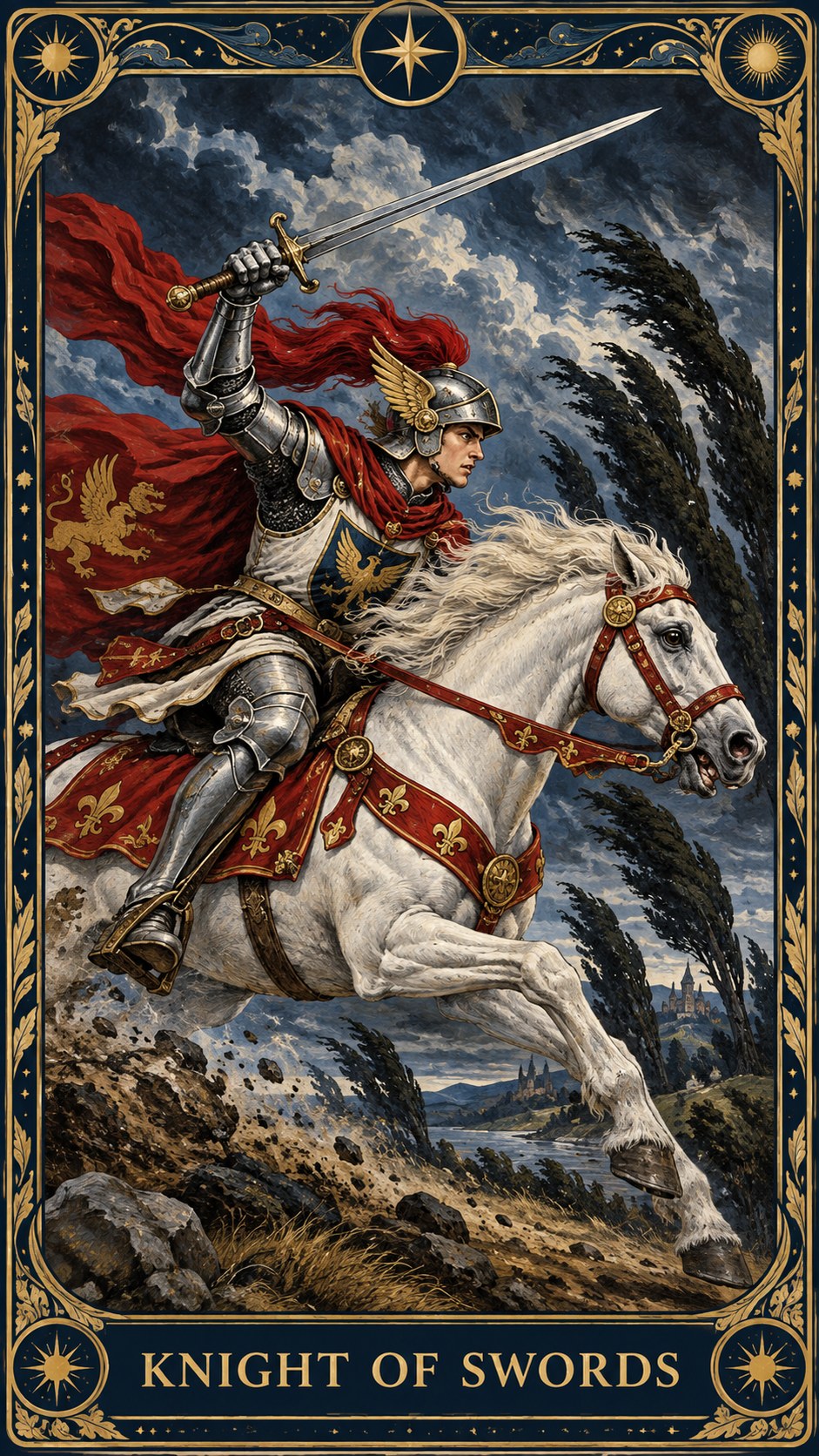
A knight drives a white horse forward with his sword raised. Wind bends the trees, ragged clouds cross the sky, and the figures on the horse's cloth reinforce the sense of rapid movement.
Upright meaning
In the Rider–Waite–Smith tradition, the Knight of Swords signifies decisive intellectual action: stating a position quickly, entering a debate, defending an idea, or cutting through an obstacle. Its strength is courage, mental speed, and willingness to act under pressure. Its risk is mistaking force for correctness—ignoring objections, escalating conflict, or moving before the facts are checked.
If it's your card today
Move quickly today if you need to, but check both your facts and your tone before sending an important message.
Commentary and alternative readings by context
Love and relationships
In relationships, it can show a direct conversation, a fast-moving connection, or a conflict that can no longer be postponed. Clarity helps; pressure and demands for an immediate answer can damage trust.
Work and decisions
At work, it suggests a sprint, an urgent project, a negotiation, the defence of a decision, or a moment to seize initiative. Move with energy, but check the evidence, consequences, and tone before launch.
As a person
As a person, it describes someone intelligent, quick, argumentative in a purposeful way, and ready to defend a position; in shadow, impatient, abrasive, and inattentive to other people's boundaries.
Reversed meaning
Reversed, the card's momentum loses direction. It can point to a rushed decision, conflict for its own sake, cutting words, a poorly chosen target, or intense mental pressure that never becomes coherent action. Its practical question is: are you defending something that matters, or merely trying to win at any cost?
Where Tarot schools disagree
The main interpretation follows Rider–Waite–Smith. The Marseille and Thoth comparisons below are attributed to named authors, because neither tradition has one universal meaning shared by every reader.
Knight of Swords Tarot Card: Tarot de Marseille Interpretation
Tarot de Marseille — Cavalier d’Épée (Paul Marteau, 1949)
Tarot de Marseille does not have one ancient, universal dictionary of meanings shared by every author. In Paul Marteau's named system in Le Tarot de Marseille (1949), the Cavalier d’Épée is read as rapid command and a reflexive decision in the face of an unexpected event. That is a specific twentieth-century interpretive school, not an original meaning inherent in every Marseille deck.
Knight of Swords Tarot Card: Crowley’s Interpretation in The Book of Thoth (1944)
Thoth — Prince of Swords (Aleister Crowley, 1944)
The closest rank correspondence in the Thoth Tarot is the Prince of Swords, 'Air of Air'. Crowley describes a powerful, inventive intellect capable of holding many ideas, but also prone to changing direction and lacking a stable purpose. The link with RWS is therefore deeper than speed: both show mental force that needs discipline and a clear aim.
Why the interpretations differ
The court hierarchies are not identical. RWS uses Page, Knight, Queen and King; Marseille uses Valet, Cavalier, Reine and Roi; Thoth uses Princess, Prince, Queen and Knight. The comparison therefore follows the function and elemental formula of the rank instead of matching an English title word for word.
Sources and method
A. E. Waite — The Pictorial Key to the Tarot (1910) · Paul Marteau — Le Tarot de Marseille (BnF, 1949) · Aleister Crowley — The Book of Thoth (1944)
Editorially checked 23 September 2026. Historical source statements are separated from TarotCards24's modern practical interpretation.
Air
Frequently asked
What does the Tarot card “Knight of Swords” mean upright?
In the Rider–Waite–Smith tradition, the Knight of Swords signifies decisive intellectual action: stating a position quickly, entering a debate, defending an idea, or cutting through an obstacle. Its strength is courage, mental speed, and willingness to act under pressure. Its risk is mistaking force for correctness—ignoring objections, escalating conflict, or moving before the facts are checked.
What does the Tarot card “Knight of Swords” mean reversed?
Reversed, the card's momentum loses direction. It can point to a rushed decision, conflict for its own sake, cutting words, a poorly chosen target, or intense mental pressure that never becomes coherent action. Its practical question is: are you defending something that matters, or merely trying to win at any cost?
What does the Tarot card “Knight of Swords” mean in love?
In relationships, it can show a direct conversation, a fast-moving connection, or a conflict that can no longer be postponed. Clarity helps; pressure and demands for an immediate answer can damage trust.
What does the Tarot card “Knight of Swords” mean for career?
At work, it suggests a sprint, an urgent project, a negotiation, the defence of a decision, or a moment to seize initiative. Move with energy, but check the evidence, consequences, and tone before launch.
What kind of person does the Tarot card “Knight of Swords” describe?
As a person, it describes someone intelligent, quick, argumentative in a purposeful way, and ready to defend a position; in shadow, impatient, abrasive, and inattentive to other people's boundaries.
More from Swords
Ready for a full reading?
Try the free 3-card weekly spread →
New to tarot?
Learn how reading works →