Swords
King of Swords Tarot Card Meaning
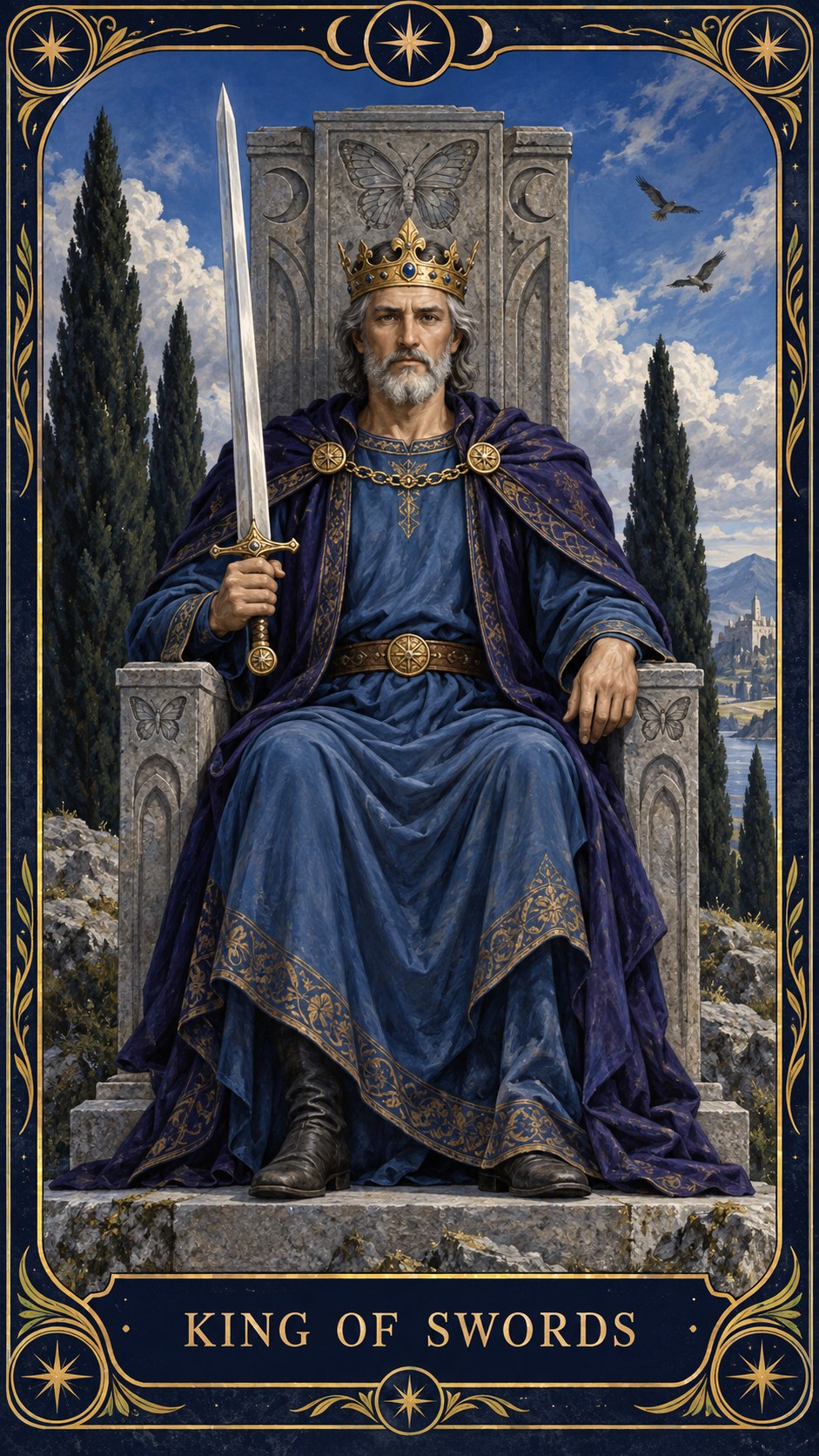
What the card shows
A king sits upright and composed, sword held precisely.
Upright meaning
Authority built on clear thinking rather than force. Upright, King of Swords is leadership through logic and fair, well-reasoned judgment.
If it's your card today
A day to lead with reasoning rather than emotion, and to actually explain your logic to others.
Commentary and alternative readings by context
Love and relationships
In love, it suggests approaching a relationship with clear thinking and honest communication rather than emotional impulse.
Work and decisions
For career, it points to leadership through logic and fair, well-reasoned judgment rather than force or favoritism.
As a person
The King of Swords can represent an incisive decision-maker who values principles, clear language, and competent advice. Their judgment is strong, but emotional distance can make others feel they are being assessed rather than heard.
Reversed meaning
Logic used to justify manipulation, or rigid thinking that won’t consider another view.
Where Tarot schools disagree
The main interpretation follows Rider–Waite–Smith. The Marseille and Thoth comparisons are attributed to named authors and works.
King of Swords Tarot Card: Tarot de Marseille Interpretation
Tarot de Marseille — Roi de Épées (Paul Marteau, 1949)
In Paul Marteau's court-card method in Le Tarot de Marseille (1949), this rank represents strength and direction that bring the suit's domain under conscious command. Swords describe action on the material plane that can open toward spiritual value. This is a named twentieth-century interpretation, not a universal ancient meaning.
King of Swords Tarot Card: Crowley’s Interpretation in The Book of Thoth (1944)
Thoth — Knight of Swords — Fire of Air (Aleister Crowley, 1944)
Crowley's exact corresponding card in The Book of Thoth (1944) is Knight of Swords — Fire of Air. Under the Golden Dawn's renaming, RWS's King becomes Thoth's Knight, the suit's highest rank — and its formula, "Fire of Air," is assertive will (Fire) directing pure thought (Air): authority expressed as decisive, active judgment rather than the more static, seated-ruler image RWS's King suggests.
Why the interpretations differ
The court hierarchies are not identical. RWS uses Page, Knight, Queen and King; Marseille uses Valet, Cavalier, Reine and Roi; Thoth uses Princess, Prince, Queen and Knight. The comparison therefore follows the function and elemental formula of the rank instead of matching an English title word for word.
Sources and method
A. E. Waite — The Pictorial Key to the Tarot (1910) · Paul Marteau — Le Tarot de Marseille (BnF, 1949) · Marteau — attributed English translation · Aleister Crowley — The Book of Thoth (1944)
Automated factual and language passes completed 23 September 2026; no human native-language review is claimed.
Air
Frequently asked
What does the Tarot card “King of Swords” mean upright?
Authority built on clear thinking rather than force. Upright, King of Swords is leadership through logic and fair, well-reasoned judgment.
What does the Tarot card “King of Swords” mean reversed?
Logic used to justify manipulation, or rigid thinking that won’t consider another view.
What does the Tarot card “King of Swords” mean in love?
In love, it suggests approaching a relationship with clear thinking and honest communication rather than emotional impulse.
What does the Tarot card “King of Swords” mean for career?
For career, it points to leadership through logic and fair, well-reasoned judgment rather than force or favoritism.
What kind of person does the Tarot card “King of Swords” describe?
As a person, this card describes the same pattern in character: Authority built on clear thinking rather than force. Upright, King of Swords is leadership through logic and fair, well-reasoned judgment. Under pressure, its shadow may look like this: Logic used to justify manipulation, or rigid thinking that won’t consider another view.
More from Swords
Ready for a full reading?
Try the free 3-card weekly spread →
New to tarot?
Learn how reading works →