Swords
Eight of Swords Tarot Card Meaning
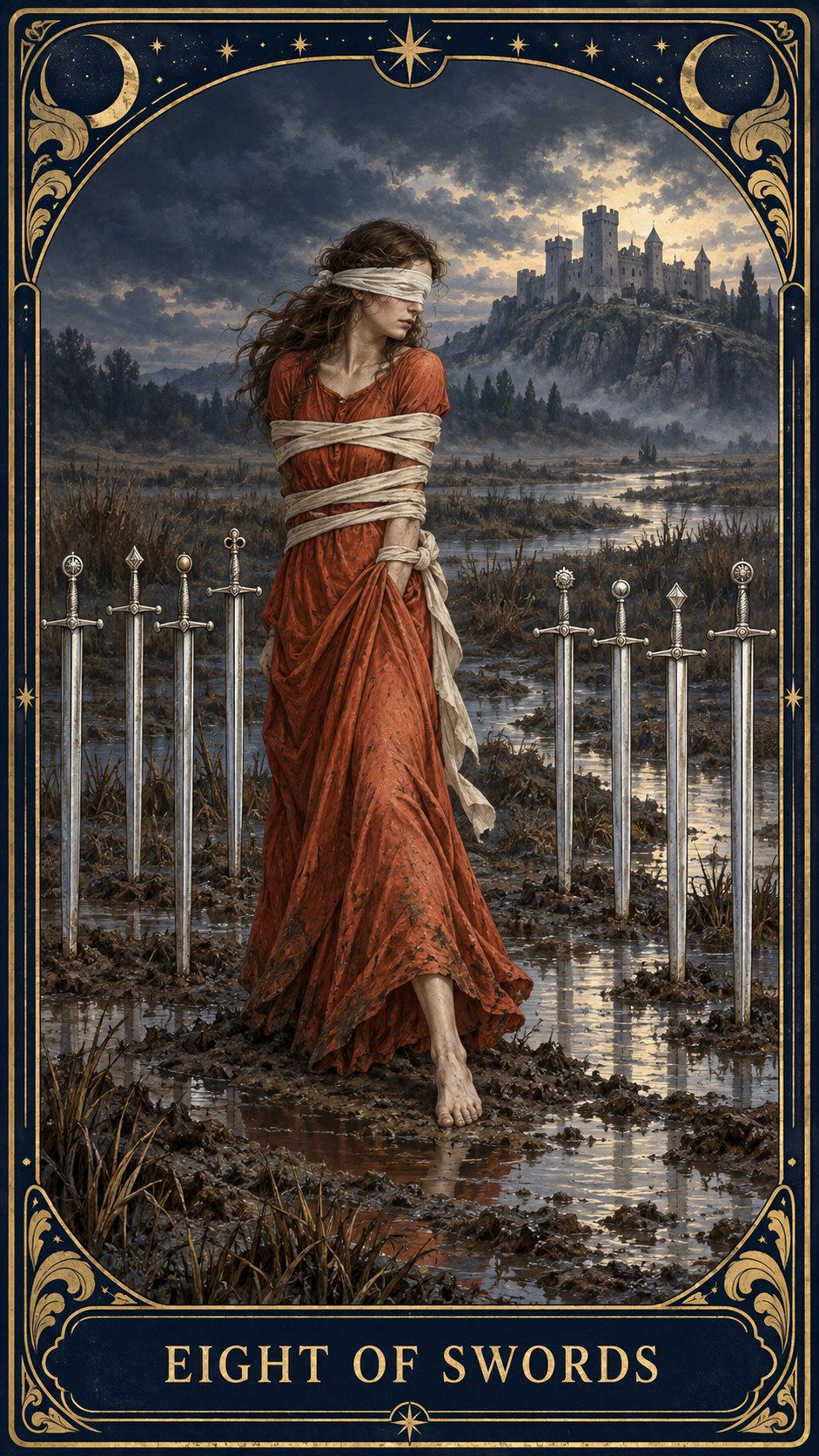
What the card shows
A blindfolded, loosely bound figure stands surrounded by eight swords.
Upright meaning
The fence isn’t as solid as it feels, and the blindfold is the real obstacle. Upright, Eight of Swords is a trap that’s mostly made of your own perspective.
If it's your card today
If you feel boxed in today, look for the gap in the fence you haven’t noticed yet.
Commentary and alternative readings by context
Love and relationships
In love, it suggests feeling trapped in a relationship dynamic that may be more changeable than it currently feels.
Work and decisions
For career, it points to feeling stuck in a job or situation due to self-imposed limits more than an actual lack of options.
As a person
This card can describe someone who sees constraints vividly and underestimates their own room to act. They are sensitive to risk, but benefit from testing assumptions with one small, safe choice.
Reversed meaning
Finally seeing the way out, or continuing to feel stuck out of habit.
Where Tarot schools disagree
The main interpretation follows Rider–Waite–Smith. The Marseille and Thoth comparisons are attributed to named authors and works.
Eight of Swords Tarot Card: Tarot de Marseille Interpretation
Tarot de Marseille — Huit de Épées (Paul Marteau, 1949)
In Paul Marteau's number-and-suit method in Le Tarot de Marseille (1949), this rank means a self-sustaining union of material stability and inner life. Swords describe action on the material plane that can open toward spiritual value. Read together, the card applies that stage to this suit's domain. This is Marteau's specific twentieth-century system.
Eight of Swords Tarot Card: Crowley’s Interpretation in The Book of Thoth (1944)
Thoth — Eight of Swords — Interference (Aleister Crowley, 1944)
Crowley's exact corresponding card in The Book of Thoth (1944) is Eight of Swords — Interference. The decan title, "Interference," ruled by Jupiter in Gemini, describes potential (Jupiter) fragmented by Gemini's scattering, dualistic air — a reading of stalled, dispersed energy that lines up much more closely with RWS's trapped-and-restricted imagery than the Marseille pip numerology does.
Why the interpretations differ
RWS builds much of the reading from Pamela Colman Smith’s narrative scene. Marseille numbered minors are usually read through number, suit and composition, while Thoth adds a printed title and astrological or decan structure. The systems can begin with the same number and suit yet emphasize different dynamics.
Sources and method
A. E. Waite — The Pictorial Key to the Tarot (1910) · Paul Marteau — Le Tarot de Marseille (BnF, 1949) · Marteau — attributed English translation · Aleister Crowley — The Book of Thoth (1944)
Automated factual and language passes completed 23 September 2026; no human native-language review is claimed.
Air
Frequently asked
What does the Tarot card “Eight of Swords” mean upright?
The fence isn’t as solid as it feels, and the blindfold is the real obstacle. Upright, Eight of Swords is a trap that’s mostly made of your own perspective.
What does the Tarot card “Eight of Swords” mean reversed?
Finally seeing the way out, or continuing to feel stuck out of habit.
What does the Tarot card “Eight of Swords” mean in love?
In love, it suggests feeling trapped in a relationship dynamic that may be more changeable than it currently feels.
What does the Tarot card “Eight of Swords” mean for career?
For career, it points to feeling stuck in a job or situation due to self-imposed limits more than an actual lack of options.
What kind of person does the Tarot card “Eight of Swords” describe?
As a person, this card describes the same pattern in character: The fence isn’t as solid as it feels, and the blindfold is the real obstacle. Upright, Eight of Swords is a trap that’s mostly made of your own perspective. Under pressure, its shadow may look like this: Finally seeing the way out, or continuing to feel stuck out of habit.
Related cards
Ready for a full reading?
Try the free 3-card weekly spread →
New to tarot?
Learn how reading works →